Protective-clothing descriptions mix material names, comfort features and test references. Those are different kinds of information. Before comparing products, identify what the claim applies to: the complete garment, one protector or a weather-related component.
Read the classification in context
REV’IT!’s explanation of EN 17092 distinguishes classes with different scopes. AAA, AA and A include defined impact and abrasion requirements, while B and C have different roles. Do not treat every label as a single ladder of complete protection.
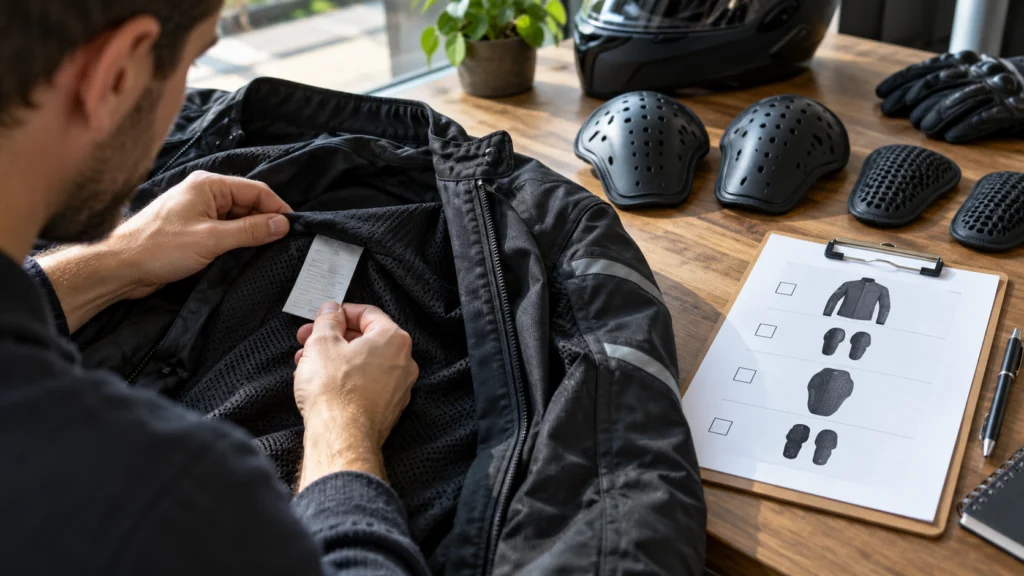
Use the exact garment documentation and declaration where available. A familiar acronym in advertising is not enough if the actual model and class are unclear. Ask a knowledgeable supplier or the manufacturer for clarification.
| Class group | General scope described by the manufacturer | Question |
|---|---|---|
| AAA, AA, A | Garments with impact and abrasion requirements at different classes | What is the exact model’s class? |
| B | Abrasion-focused garment without included impact protection | What additional compatible protection is required? |
| C | Holder of impact protectors for covered areas | What garment combination is intended? |
Keep fit and condition in the decision
A classification does not establish that a particular size fits you or that a used garment is undamaged. Try the intended layers and seek suitable fitting advice. Do not remove parts or alter the garment to imitate a different product.
Individual protector markings describe those components. They should not be substituted for the complete garment’s information. Weatherproofing or ventilation claims also answer different questions from abrasion and impact testing.
- Identify the exact garment and claim.
- Read the complete label and documentation.
- Separate garment, protector and weather features.
- Ask about fit, care and intended combinations.
Avoid a guarantee interpretation
Testing provides defined information under specified conditions. It cannot promise that a rider will avoid injury in every event. Do not convert a class into an invented safe speed or a permission to accept more road risk.
Compare suitability and practical care alongside the documentation. A clear explanation of limitations is more useful than a slogan describing one product as universally safest.
Questions and answers
Does a CE mark guarantee no injury?
No. Certification information does not remove all real-world risk.
Can a protector label describe the whole jacket?
Not by itself. Garment and protector information have different scopes.
Can a class be translated into a safe riding speed?
Do not invent that conversion. Follow official and manufacturer information and responsible riding practice.
Sources: support.revitsport.com.