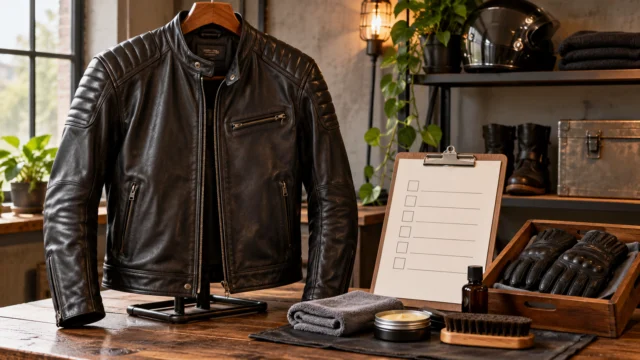
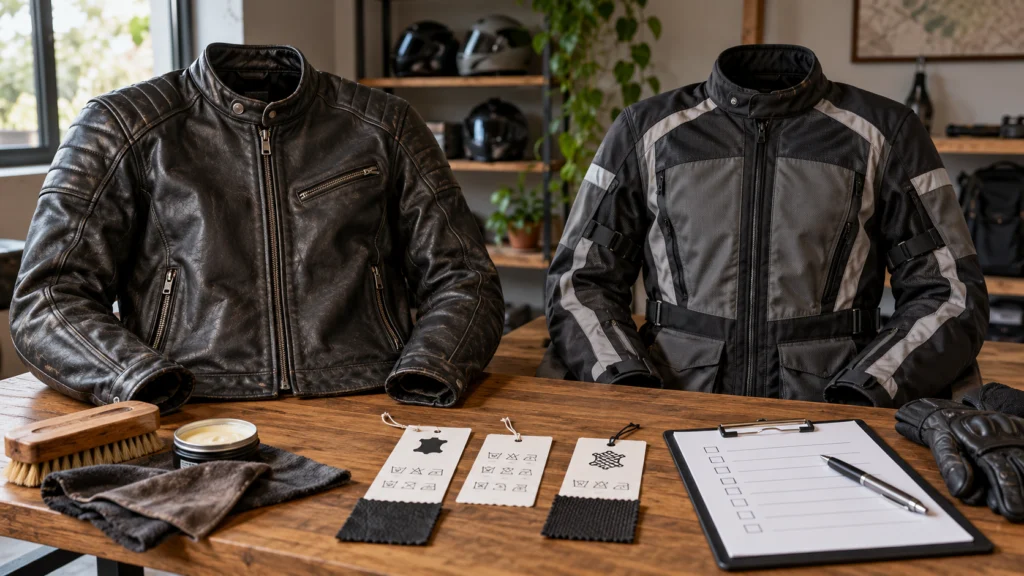
Leather and textile describe materials, not complete levels of protection. The garment’s construction, certification, fit and condition matter. A useful comparison starts with the actual jackets and the riding conditions, rather than a rule that one material always wins.
Read the garment information
Check the exact model, labels and manufacturer documentation. Under the EN 17092 framework explained by REV’IT!, clothing classes distinguish different tested requirements. Do not infer a class from appearance or from a protector label alone.
Certification is not a guarantee against injury. It gives information about defined testing and requirements, while correct fit and suitable use remain important. Ask a knowledgeable specialist to explain unfamiliar labels.
| Area | Question | Avoid |
|---|---|---|
| Protection information | What is the garment’s documented classification? | Judging by material alone |
| Fit | Does it suit the riding position and intended layers? | A fashion-only standing fit |
| Weather | What does the actual construction provide? | Assuming every textile is waterproof |
| Care | How are shell and layers maintained? | One cleaning recipe for everything |
Try the intended combination
Use the layers and other gear you expect to wear. Check closures and movement in an appropriate fitting setting. A jacket that looks right on a hanger can become uncomfortable in the intended posture.
Ask how protectors should sit and how the garment is designed to connect with other items where applicable. Do not improvise modifications to solve a poor fit or remove protective parts simply to make the jacket feel roomier.
- Compare exact product documentation.
- Try the jacket with intended layers.
- Check weather and care requirements separately.
- Use qualified fitting advice where unsure.
Include ownership tasks
A jacket needs cleaning, drying, inspection and suitable storage. A weather feature can add care requirements rather than eliminate them. Read the labels for removable liners and other components separately.
Choose a product you can maintain correctly and afford within the full riding budget. A higher price or prestigious material name does not remove the need to verify suitability.
Questions and answers
Is leather automatically more protective than every textile?
The material name alone cannot establish the complete garment’s performance. Use documented classification, construction and fit.
Does textile always mean waterproof?
No. Check the specific product and layers rather than assuming a category-wide feature.
Can I compare only the protector labels?
No. Garment classification and individual protector information describe different parts of the system.
Sources: support.revitsport.com; support.revitsport.com.